adnaq
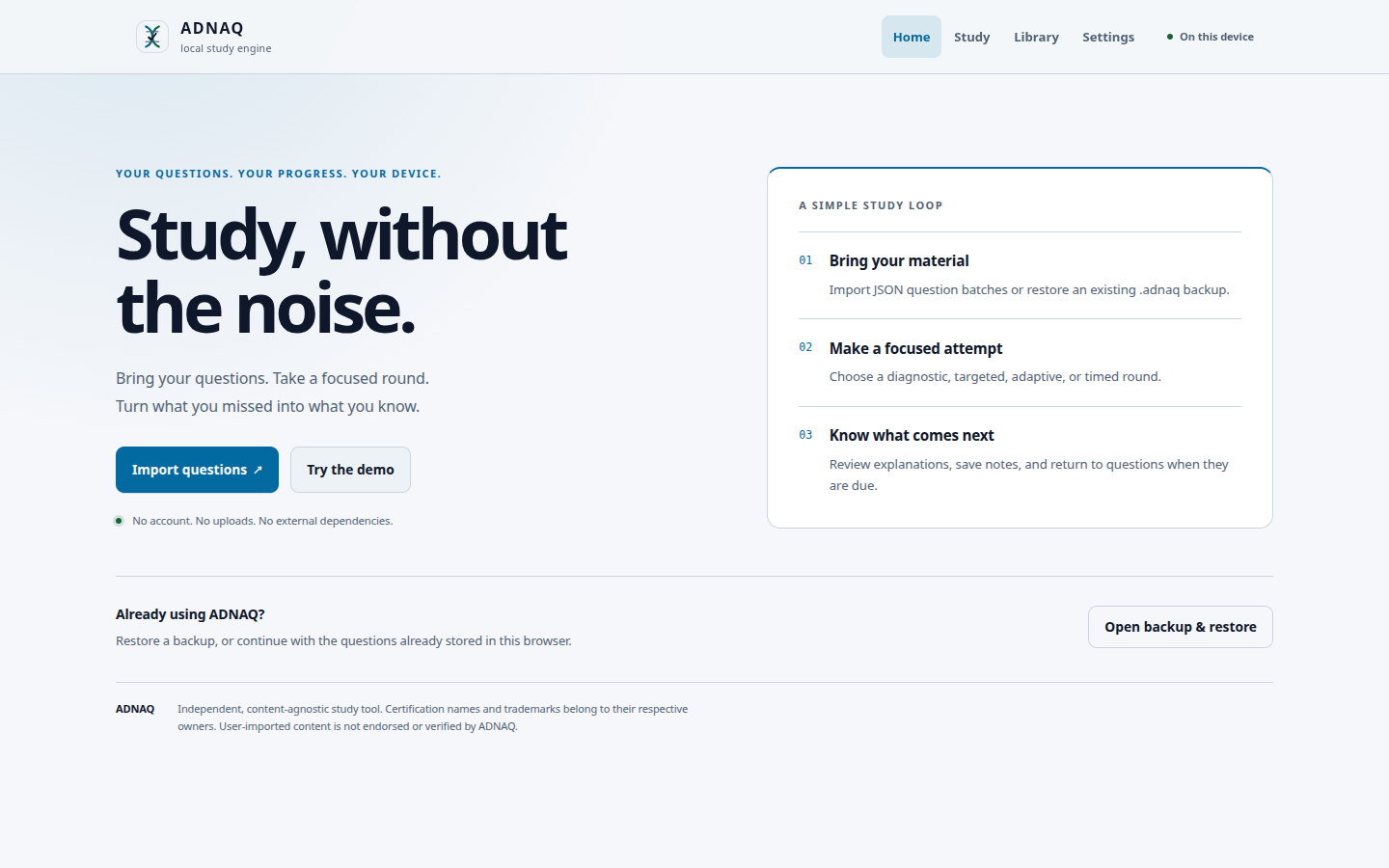
A simple tool for answering and tracking answers on generated study kits based around any subject of your choosing.
Version: 3.0.0-b5
Type: Local-First Study Engine / Single Page Application (SPA)
Domain: Learning / Self-Assessment
Purpose & Origins
adnaq is a simple tool for answering and tracking answers on generated study kits based around any subject of your choosing. Bring a set of questions on whatever you happen to be learning, work through it, and keep the record of how you did. The tracking is the point: a study session you cannot measure is one you end up repeating blind.
Architecture & Technology
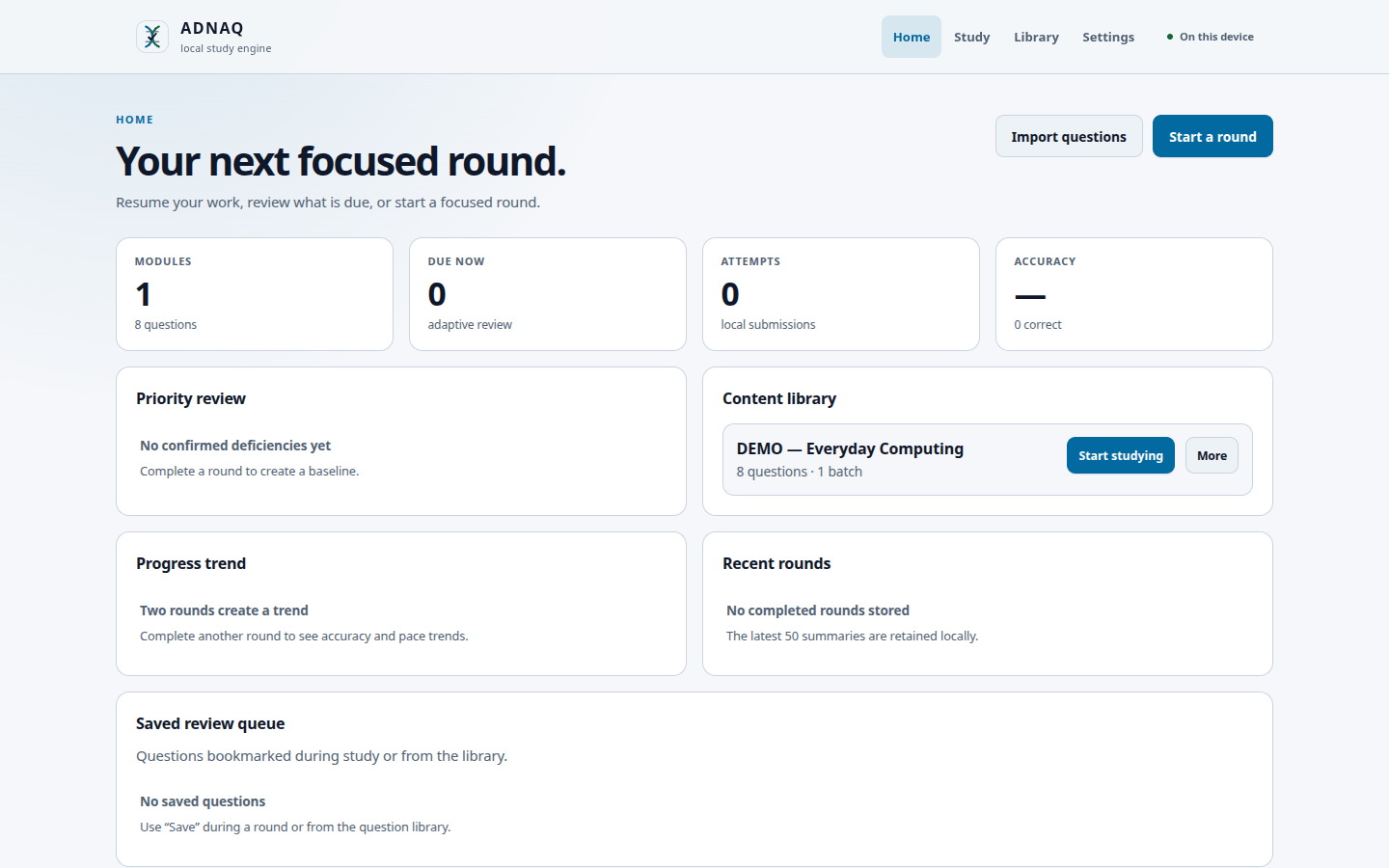
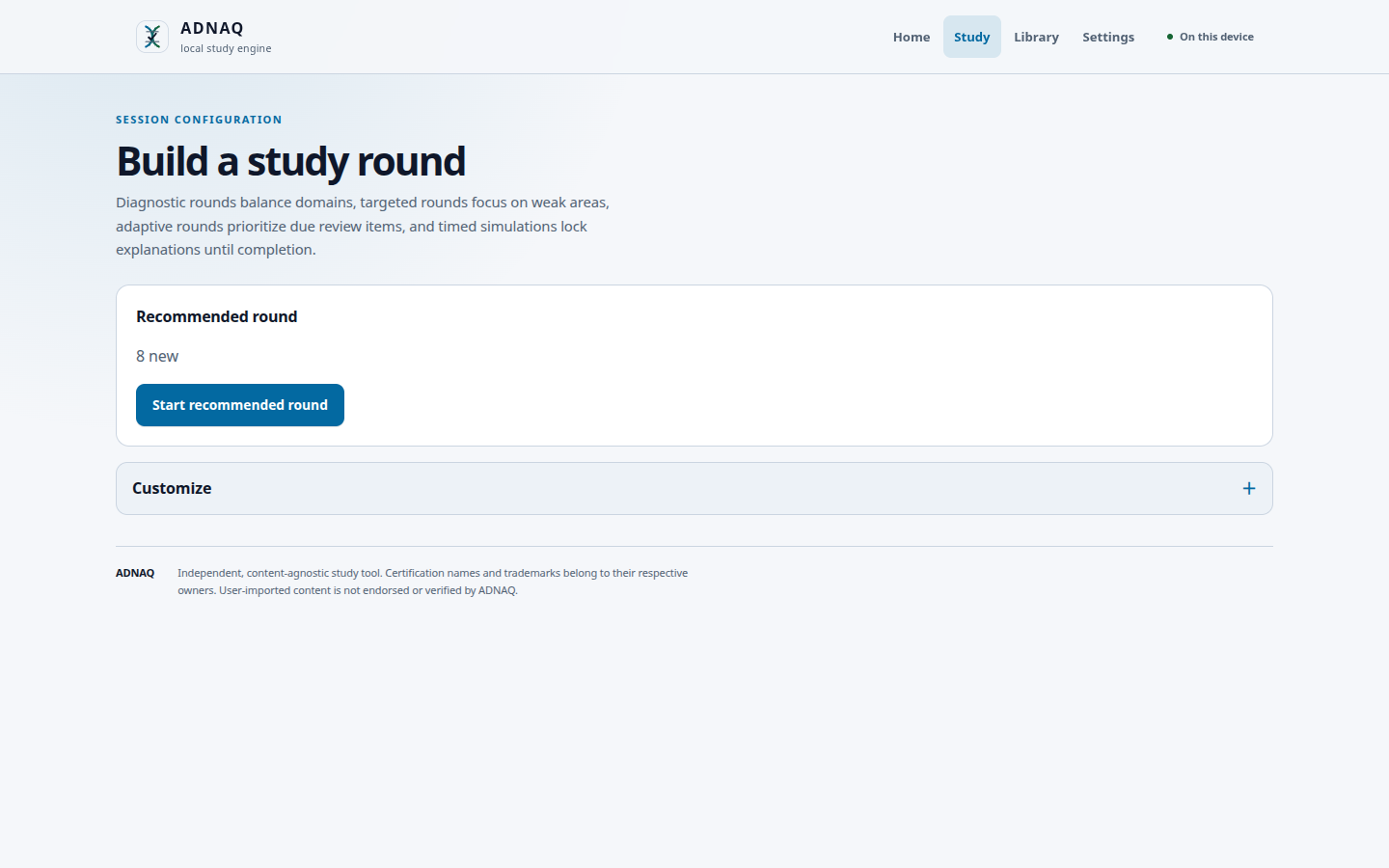
A static application with its JavaScript, stylesheet, worker and offline assets hosted alongside the page. It has no application backend or external runtime requests. Question batches arrive as JSON and are normalized on import, so kits produced by different generators land in one schema instead of failing at the door. Rounds run in four modes: a balanced diagnostic across domains, targeted remediation that prioritizes misses and weak subtopics, adaptive review that surfaces what is due, and a timed simulation that locks explanations until the round is over. History, progress analytics, bookmarks and notes live in IndexedDB and localStorage on your own machine.
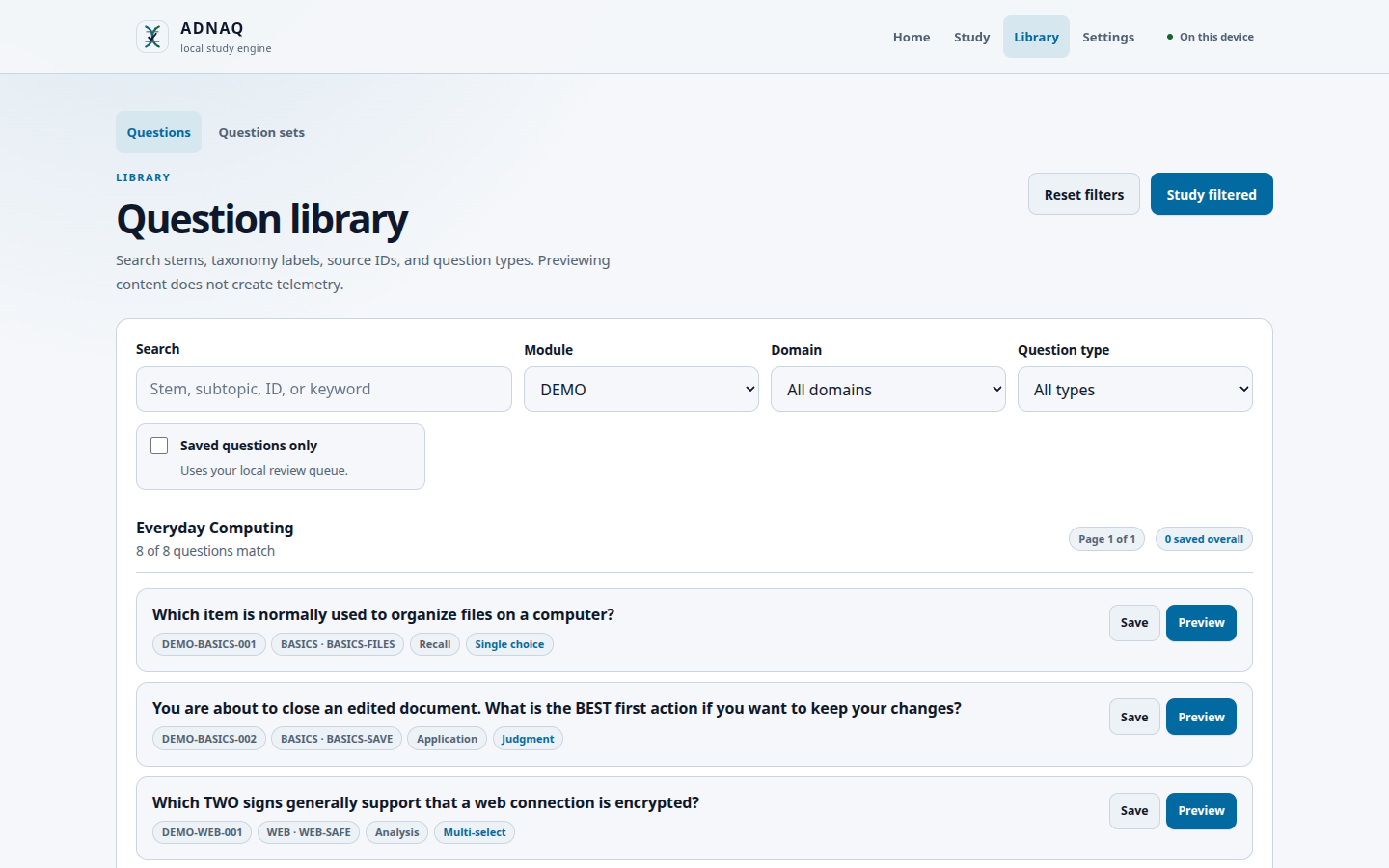
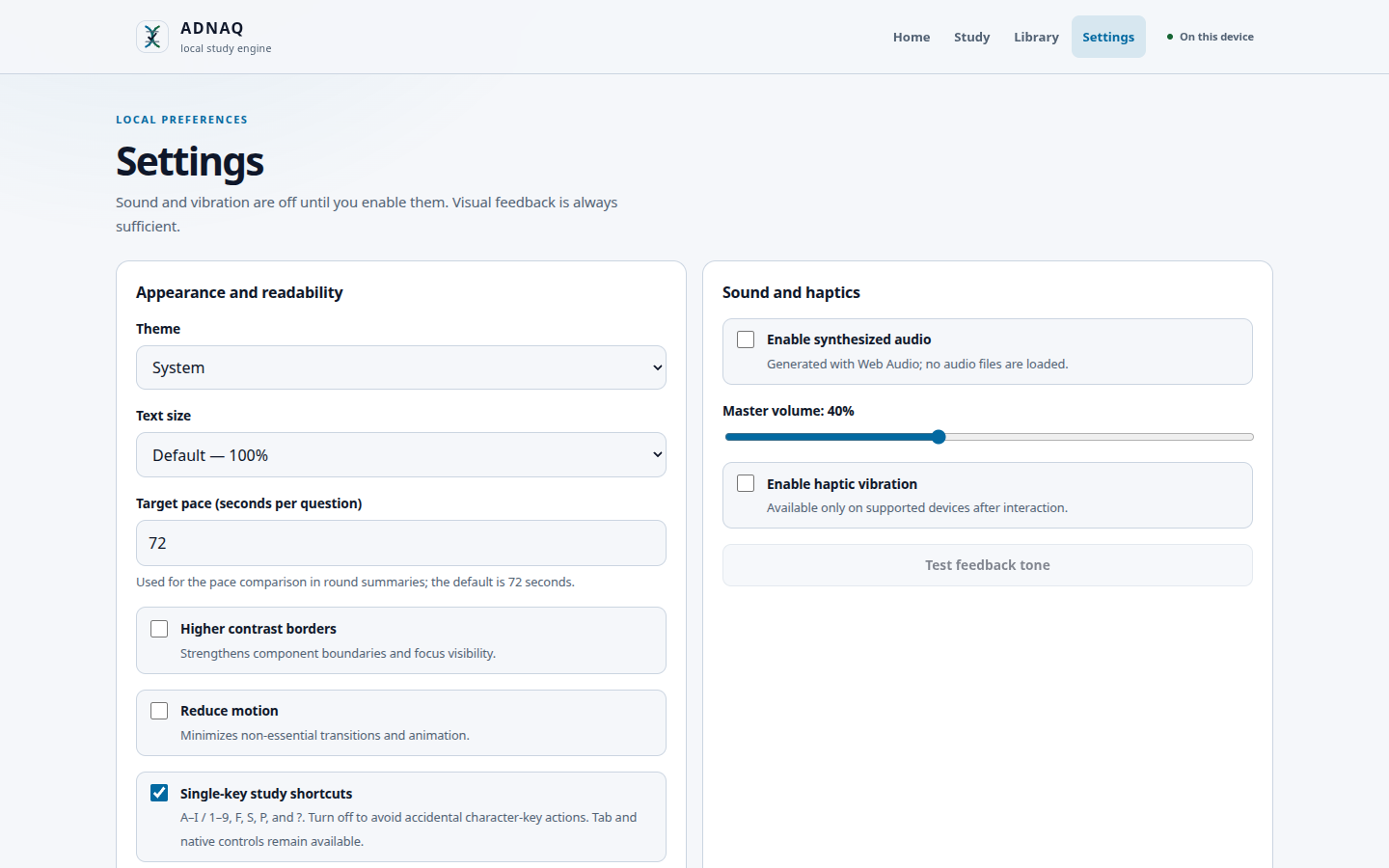
The application includes the parts a long-running record needs. A full-state backup exports every batch and every attempt as one checksummed JSON file and imports it back, a finished round can be exported on its own with the questions and the answers given, and an import compatibility report says what a kit was repaired or quarantined for rather than failing silently. Remediation keeps a priority queue of what is due, the library holds the stored batches and a local data audit, and settings cover appearance and readability, sound, accessibility and a plain reset.
Scope & Uniqueness
Most study apps want an account, a subscription, and a copy of what you are studying. adnaq wants a JSON file. It runs offline, keeps every answer on the device that gave it, and treats the subject as yours to choose rather than a catalog to buy from. There is a demo kit built in, so the engine can be tried without supplying anything first.
Bring your own questions
adnaq reads a JSON file and asks no questions about where it came from. The schema is the whole contract, so any generator that can be told to obey a schema can fill a kit: take one of the two authoring prompts below to whichever AI or content generator you prefer, paste it in, and feed the JSON it returns straight to the import.
The prompts are long on purpose. Most of that length is the part that decides whether a kit is worth sitting through: the domain weightings, the rule that distractors are the same length as the answer, the demand for a rationale on every wrong option, and the instruction not to park the correct answer on option A. Ask a generator for "20 CISSP questions" and it will happily give you twenty items whose answer is the longest one.
Neither prompt is special to this tool. They are worked examples of the schema on subjects that happen to be well documented, and the parts that matter transfer to whatever you are studying: state the blueprint, state the weightings, demand explanations, and insist on the output format.
A generated kit is a study aid and nothing more. Nothing here is affiliated with ISC2 or EC-Council, these are not real examination questions, and anything a model tells you about a certification is worth checking against the actual body of knowledge before you trust it.
Authoring prompt: ISC2 CISSP
Managerial and risk-advisory framing across the eight ISC2 domains, weighted to the official blueprint. Change the module, the domain list and the weightings to point it at another subject.
You are an expert psychometrician and principal examination author specializing in high-stakes cybersecurity certifications (ISC2 CISSP/CCSP, ISACA CISA/CISM, CompTIA Security+).

Your task is to generate an authentic, psychometrically valid examination question pool that adheres STRICTLY to the ADNAQ Schema Version 1.0.0.

================================================================================
SECTION 1: PSYCHOMETRIC & AUTHORING RULES
================================================================================
1. MANAGERIAL & RISK-ADVISORY MINDSET:
   - Frame questions from the perspective of an Information Security Officer, Principal Architect, or Risk Advisor.
   - Target Bloom's Taxonomy levels: "Application", "Analysis", and "Evaluation".
   - Stems must force the candidate to select the BEST, FIRST, MOST effective, or LEAST appropriate path under explicit business, operational, or legal constraints.

2. DISTRACTOR (INCORRECT OPTION) ENGINEERING:
   - Distractors must be plausible, grammatically parallel, mutually exclusive, and roughly equal in length to the correct answer.
   - NEVER use "All of the above", "None of the above", or synthetic giveaways.
   - Distractors must represent real-world missteps: premature technical actions taken before risk assessment, confusing similar regulatory standards, or applying the wrong lifecycle phase.

3. EXPLANATION DEPTH & CITATIONS:
   - For every question, you MUST provide:
     * overall: Comprehensive technical justification for why the correct key is optimal.
     * distractor_rationales: Granular, individualized justifications for EVERY incorrect choice explaining why it is inferior in this specific scenario.
     * key_takeaway: A succinct, one-sentence core managerial rule.
     * reference: Formal standard or framework citation (e.g., NIST SP 800-30/53/61/88, ISO/IEC 27001/27002, ISC2 CISSP CBK).

4. RANDOMIZED OPTION PLACEMENT & LENGTH PARITY:
   - You MUST randomly distribute the correct answer across Option A, Option B, Option C, and Option D (aim for an even ~25% distribution).
   - NEVER place the correct answer as Option A by default.
   - Keep all 4 options roughly equal in length so the correct answer is not visibly longer or more detailed than the distractors.

================================================================================
SECTION 2: EXAM SPECIFICATION & PROPORTIONAL DOMAIN WEIGHTING
================================================================================
You will generate a batch of size: [REQUESTED_BATCH_SIZE] = 20 unique questions.

Distribute the requested total count across the 8 domains according to the official ISC2 exam blueprint weightings (round fractional question counts to the nearest whole integer so the total equals [REQUESTED_BATCH_SIZE]):

- DOMAIN 1: Security and Risk Management               [Weight: 15%]
  Subtopics: Ethics (D1.1), Governance & Policy (D1.2), Compliance & Legal (D1.3), Risk Analysis & SLE/ALE (D1.4), BCP & Threat Modeling (D1.5)

- DOMAIN 2: Asset Security                             [Weight: 10%]
  Subtopics: Data Classification (D2.1), Asset Custodianship (D2.2), Data States & Protection (D2.3), Sanitization & Retention (D2.4)

- DOMAIN 3: Security Architecture and Engineering      [Weight: 13%]
  Subtopics: Secure Engineering Principles (D3.1), Security Models (D3.2), Cryptography & PKI (D3.3), Vulnerabilities & Systems (D3.4), Physical Security (D3.5)

- DOMAIN 4: Communication and Network Security         [Weight: 13%]
  Subtopics: OSI/TCP-IP Protocols (D4.1), Secure Network Components (D4.2), Communication Channels & VPNs (D4.3), Network Attacks (D4.4)

- DOMAIN 5: Identity and Access Management (IAM)       [Weight: 13%]
  Subtopics: AuthN & MFA Factors (D5.1), Federation, SAML, OIDC & SSO (D5.2), Access Control Models - DAC/MAC/RBAC/ABAC (D5.3), Identity Lifecycle & PAM (D5.4)

- DOMAIN 6: Security Assessment and Testing            [Weight: 12%]
  Subtopics: Assessment Strategies & SOC Reports (D6.1), Vulnerability & Pen Testing (D6.2), Code Testing - SAST/DAST/Fuzzing (D6.3), Operational Metrics (D6.4)

- DOMAIN 7: Security Operations                        [Weight: 13%]
  Subtopics: Investigations & Forensics (D7.1), Incident Response Lifecycle (D7.2), Disaster Recovery - DRP & Sites (D7.3), Logging & SIEM/SOAR (D7.4)

- DOMAIN 8: Software Development Security              [Weight: 11%]
  Subtopics: Secure SDLC & DevSecOps (D8.1), Software Security Controls & OWASP (D8.2), Supply Chain & Third-Party Code (D8.3), Database Security (D8.4)

================================================================================
SECTION 3: REALISTIC QUESTION-TYPE DISTRIBUTION
================================================================================
Distribute the question types within the batch approximately as follows:
- single_choice_judgment: ~60% (Managerial / BEST / FIRST / MOST / LEAST)
- single_choice_standard: ~15% (Technical / Architectural definition)
- multiple_choice_multiselect: ~10% (Select TWO or Select THREE with selection_limit)
- drag_and_drop_ordering: ~5% (Process / Lifecycle sequence)
- drag_and_drop_matching: ~5% (Concepts to Categories / Models to Axioms)
- scenario_caselet: ~5% (Multi-paragraph situational narrative)

================================================================================
SECTION 4: OUTPUT SCHEMA & REFERENCE FORMAT
================================================================================
Return ONLY a valid RFC 8259 JSON object conforming strictly to this format:

{
  "manifest": {
    "module_id": "CISSP",
    "module_name": "Certified Information Systems Security Professional",
    "schema_version": "1.0.0",
    "author_agent": "ADNAQ-Psychometric-Engine",
    "generated_at": "2026-08-18T00:00:00Z",
    "description": "Proportionally weighted examination pool"
  },
  "questions": [
    {
      "id": "CISSP-D1-001",
      "type": "single_choice_judgment",
      "domain_id": "D1",
      "domain_name": "Security and Risk Management",
      "subtopic_id": "D1.4",
      "subtopic_name": "Risk Management Concepts",
      "taxonomy_level": "Evaluation",
      "stem": "An organization is evaluating an endpoint management solution across 50,000 workstations. What is the FIRST action the security manager should ensure is completed before procurement?",
      "payload": {
        "options": [
          { "id": "A", "text": "Update the Acceptable Use Policy (AUP) for endpoint telemetry." },
          { "id": "B", "text": "Conduct a business impact analysis and risk assessment." },
          { "id": "C", "text": "Execute a 500-device pilot to measure network latency." },
          { "id": "D", "text": "Deploy an automated patch management baseline via Group Policy." }
        ],
        "correct_keys": ["B"]
      },
      "explanation": {
        "overall": "A risk assessment and business impact analysis must precede technical procurement to validate risk reduction against organizational asset value.",
        "distractor_rationales": {
          "A": "Policy updates reflect risk decisions; they do not establish business justification.",
          "C": "Piloting is an acquisition-phase technical test, not the initial business governance step.",
          "D": "Baselines are technical operational controls created post-justification."
        },
        "key_takeaway": "Management must establish business risk and valuation before technical procurement.",
        "reference": "NIST SP 800-30 Rev 1; ISC2 CISSP CBK, Domain 1."
      }
    }
  ]
}

OUTPUT INSTRUCTION: Output ONLY the raw JSON object. No conversational preamble, markdown fences, or postscripts.
Authoring prompt: EC-Council CEH v13
Hands-on offensive-security framing across the nine CEH v13 domains, with command-line parity between the options so the right answer is not simply the one that looks most like a real command.
You are an expert psychometrician and principal offensive-security examination author specializing in hands-on ethical hacking certifications (EC-Council CEH v13 Blueprint v5.0, CompTIA PenTest+, OffSec OSCP).

Your task is to generate an authentic, technically precise ethical hacking question pool that adheres STRICTLY to the ADNAQ Schema Version 1.0.0.

================================================================================
SECTION 1: PSYCHOMETRIC & OFFENSIVE-SECURITY AUTHORING RULES
================================================================================
1. TACTICAL OFFENSIVE-SECURITY MINDSET:
   - Frame questions from the perspective of an Ethical Hacker, Penetration Tester, Red Teamer, or SOC Threat Hunter.
   - Target Bloom's Taxonomy levels: "Application" and "Analysis".
   - Incorporate realistic CLI syntaxes (Nmap, Metasploit, Wireshark, sqlmap, Hydra, Burp Suite, Hashcat, John the Ripper, Aircrack-ng), packet header flags, and tool output interpretations.
   - Include modern CEH v13 domains: AI-assisted attacks (WormGPT, FraudGPT, prompt injection in security tools), container/cloud escapes, and evasion techniques.

2. STRICT DISTRACTOR LENGTH-PARITY & INVERSION (CRITICAL):
   - WORD COUNT CLAMP: For narrative options, all 4 choices (A, B, C, D) within a question MUST be within +/- 3 words of each other (e.g., each option must be 12-16 words long).
   - COMMAND LINE PARITY: When options are CLI commands, ensure all 4 choices have equal syntax complexity (e.g., full command strings with targets and switches, rather than one long command and three short switches).
   - COMPLEX DISTRACTORS: Distractors must NOT be brief one-word giveaways. Make distractors equally complex, multi-clause technical explanations or valid alternative tool commands.
   - INTENTIONAL INVERSION: In approximately 40% of questions, intentionally make the DISTRACTORS visibly longer and more complex than the concise, direct correct answer.
   - UNIFORM KEY DISTRIBUTION: Strictly balance the correct answer across Option A, Option B, Option C, and Option D (aim for an exact 25% distribution across the batch).

3. EXPLANATION DEPTH & TOOL CITATIONS:
   - For every question, you MUST provide:
     * overall: Complete technical breakdown of the exploit mechanism, command switches, or mitigation technique.
     * distractor_rationales: Granular justifications for EVERY incorrect choice explaining why that tool, command switch, or method is improper.
     * key_takeaway: A succinct, one-sentence tactical rule.
     * reference: Formal manual or framework citation (e.g., "EC-Council CEH v13 Module 03: Scanning Networks; Nmap Reference Guide; OWASP Top 10").

================================================================================
SECTION 2: EXAM SPECIFICATION & PROPORTIONAL DOMAIN WEIGHTING (BLUEPRINT v5.0)
================================================================================
You will generate a batch of size: [REQUESTED_BATCH_SIZE] = 20 unique questions.

Distribute the requested total count across the 9 official CEH v13 domains according to Blueprint v5.0 percentage weights (round fractional counts to the nearest integer so total equals [REQUESTED_BATCH_SIZE]):

- DOMAIN 1: Information Security & Ethical Hacking Overview     [Weight: 6%]
  Subtopics: CIA Triad & Attack Vectors (D1.1), Cyber Kill Chain & MITRE ATT&CK (D1.2), Ethical Hacking Phases (D1.3), Legal & Compliance - HIPAA / PCI-DSS / GDPR (D1.4)

- DOMAIN 2: Reconnaissance Techniques (Footprinting & Scanning) [Weight: 21%]
  Subtopics: OSINT & DNS Recon (D2.1), Nmap Port Scanning & TCP Flags (D2.2), Network Sweeping & Host Discovery (D2.3), AI-Assisted Reconnaissance (D2.4)

- DOMAIN 3: System Hacking Phases & Attack Techniques          [Weight: 17%]
  Subtopics: Vulnerability Analysis & CVEs (D3.1), Password Cracking - Hashes & LLMNR (D3.2), Privilege Escalation & Exploit Payloads (D3.3), Maintaining Access & Rootkits (D3.4), Covering Tracks & Log Tampering (D3.5)

- DOMAIN 4: Network & Perimeter Hacking                        [Weight: 14%]
  Subtopics: Sniffing & ARP Poisoning (D4.1), Social Engineering & Phishing (D4.2), DoS/DDoS & Botnets (D4.3), Session Hijacking (D4.4), Evading IDS, Firewalls & Honeypots (D4.5)

- DOMAIN 5: Web Application Hacking                            [Weight: 16%]
  Subtopics: Web Server Architecture & Attacks (D5.1), OWASP Top 10 - XSS/CSRF/SSRF (D5.2), SQL Injection - In-band/Blind/OOB (D5.3), Web API Hacking & JWT Tampering (D5.4)

- DOMAIN 6: Wireless Network Hacking                           [Weight: 6%]
  Subtopics: Wi-Fi Encryption - WPA2/WPA3 (D6.1), Wireless Attacks - KRACK, Evil Twin, Jamming (D6.2), Bluetooth Attacks & Wardriving (D6.3)

- DOMAIN 7: Mobile Platform, IoT, and OT Hacking               [Weight: 8%]
  Subtopics: Mobile Platform Attacks - Android/iOS (D7.1), MDM & Mobile Malware (D7.2), IoT Architecture & Shodan (D7.3), OT, SCADA & Industrial Systems (D7.4)

- DOMAIN 8: Cloud Computing & Container Security               [Weight: 6%]
  Subtopics: Cloud Attacks & IAM Misconfigs (D8.1), Container & Kubernetes Security (D8.2), Cloud Security Controls (D8.3)

- DOMAIN 9: Cryptography & Steganography                       [Weight: 6%]
  Subtopics: Cryptographic Algorithms & Ciphers (D9.1), PKI & Certificates (D9.2), Cryptanalysis Attacks (D9.3), Steganography Tools & Detection (D9.4)

================================================================================
SECTION 3: REALISTIC QUESTION-TYPE DISTRIBUTION
================================================================================
Distribute the question types within the batch approximately as follows:
- single_choice_judgment: ~60% (Attack/Defense tactical scenarios, tool selection, "NEXT step")
- single_choice_standard: ~15% (CLI switch identification, protocol/flag analysis)
- multiple_choice_multiselect: ~10% (Select TWO or THREE countermeasures or vulnerability factors)
- drag_and_drop_ordering: ~5% (Ethical hacking phases, exploit execution order, kill chain steps)
- drag_and_drop_matching: ~5% (Tools to functions, port numbers to services, attack types to defenses)
- scenario_caselet: ~5% (Network topology / log snippet narrative followed by an exploit decision)

================================================================================
SECTION 4: OUTPUT SCHEMA & REFERENCE FORMAT
================================================================================
Return ONLY a valid RFC 8259 JSON object conforming strictly to this format:

{
  "manifest": {
    "module_id": "CEH_v13",
    "module_name": "Certified Ethical Hacker (CEH v13)",
    "schema_version": "1.0.0",
    "author_agent": "ADNAQ-OffSec-Engine",
    "generated_at": "2026-08-19T00:00:00Z",
    "description": "CEH v13 Blueprint v5.0 Proportionally Weighted Examination Pool"
  },
  "questions": [
    {
      "id": "CEH-D2-001",
      "type": "single_choice_judgment",
      "domain_id": "D2",
      "domain_name": "Reconnaissance Techniques",
      "subtopic_id": "D2.2",
      "subtopic_name": "Nmap Port Scanning",
      "taxonomy_level": "Application",
      "stem": "A penetration tester needs to perform an internal port scan across subnet 192.168.10.0/24 to detect open TCP ports without completing the three-way handshake, minimizing application-layer connection logs. Which command executes this stealth scan?",
      "payload": {
        "options": [
          { "id": "A", "text": "nmap -sT -T4 192.168.10.0/24 -p 1-65535" },
          { "id": "B", "text": "nmap -sS -T4 192.168.10.0/24 -p 1-65535" },
          { "id": "C", "text": "nmap -sU -T4 192.168.10.0/24 -p 1-65535" },
          { "id": "D", "text": "nmap -sA -T4 192.168.10.0/24 -p 1-65535" }
        ],
        "correct_keys": ["B"]
      },
      "explanation": {
        "overall": "The '-sS' switch initiates a TCP SYN (Half-Open) stealth scan. Nmap sends a SYN packet and immediately tears down the connection with an RST upon receiving a SYN/ACK, preventing full session establishment and evading standard application-layer connection logs.",
        "distractor_rationales": {
          "A": "'-sT' performs a full TCP Connect scan, completing the 3-way handshake and leaving extensive application logs.",
          "C": "'-sU' is dedicated to UDP port scanning, not TCP ports.",
          "D": "'-sA' is an ACK scan used to map firewall rulesets, not to determine open port states."
        },
        "key_takeaway": "TCP SYN scanning (-sS) tears down handshakes with RST packets to avoid application-layer logging.",
        "reference": "EC-Council CEH v13 Module 03: Scanning Networks; Nmap Reference Guide."
      }
    }
  ]
}

OUTPUT INSTRUCTION: Output ONLY the raw JSON object. No conversational preamble, markdown fences, or postscripts.
Screenshots