plusminus
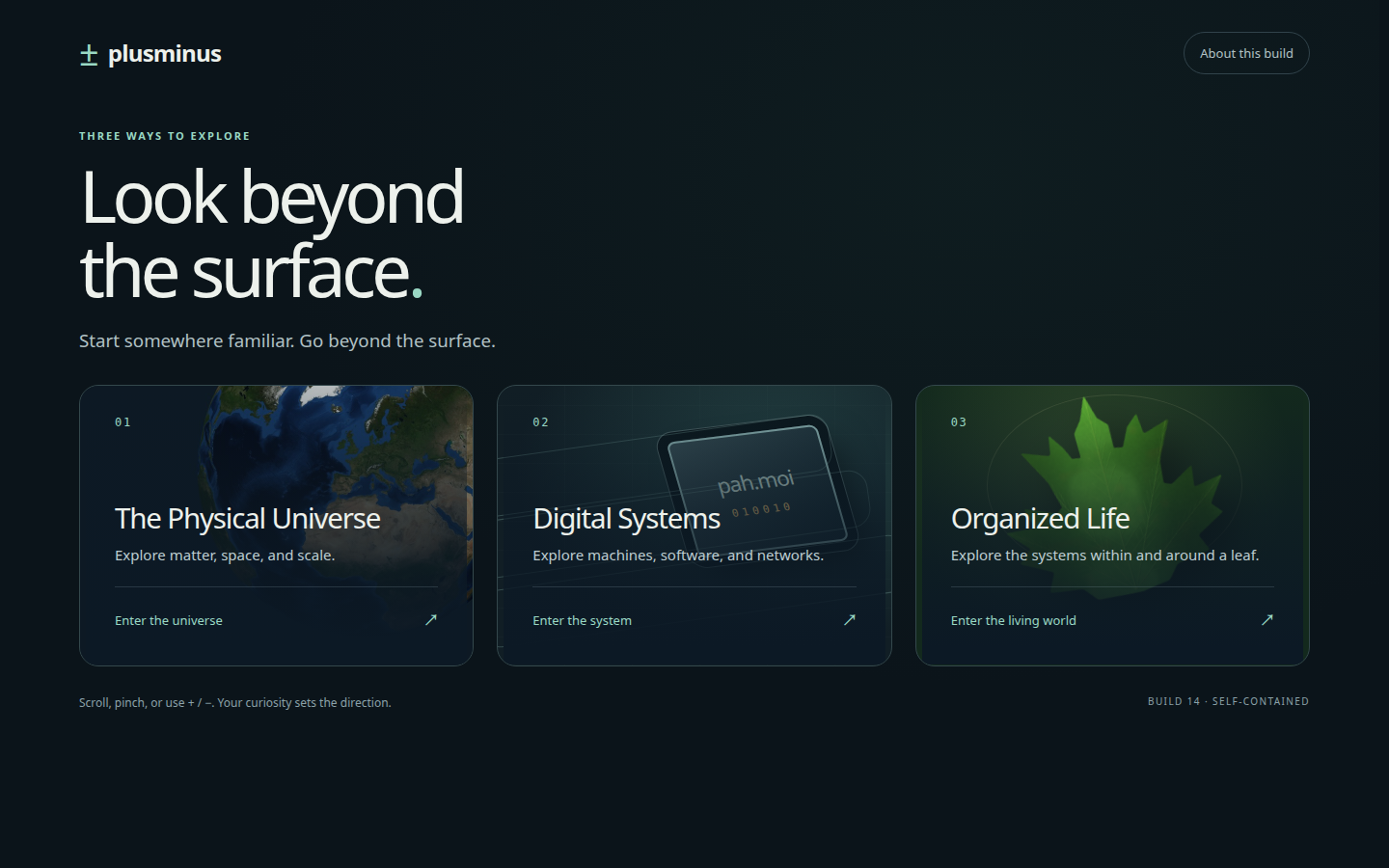
An interactive exploration of physical scale, digital systems, and organized life. Start somewhere familiar, then zoom outward for context or inward to investigate the structures and processes that make it possible.
Look beyond the surface.
Type: Browser-based interactive visualization and educational exploration toy.
Domain: Science communication, systems thinking, computing, biology, and interactive learning.
Purpose & Origins
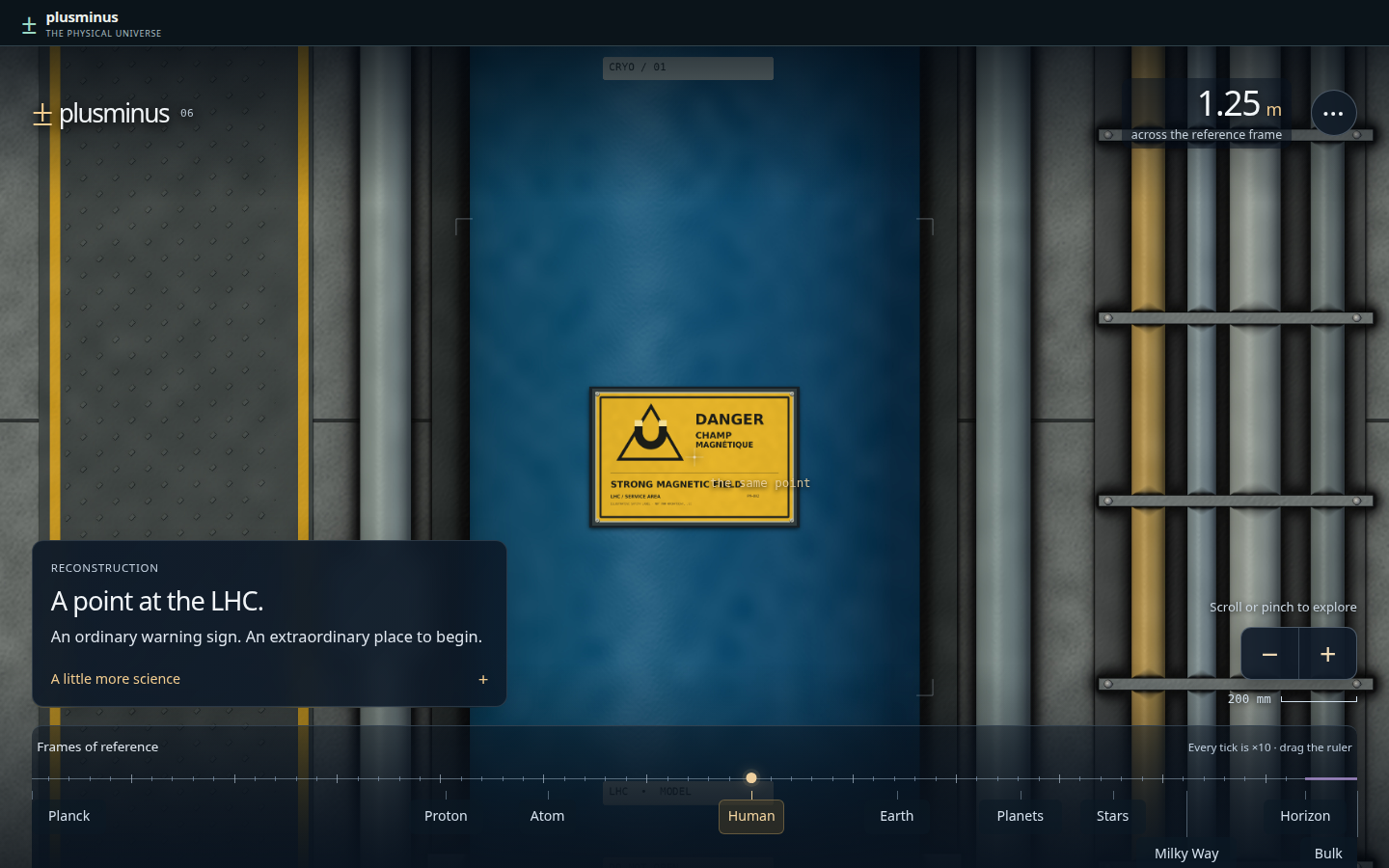
plusminus began with a simple idea: an infinitely powerful zoom lens, controlled by just a plus and a minus. Start at human scale and explore in either direction, retaining a connection to the same familiar point as the world becomes increasingly unfamiliar.
The project grew beyond physical magnification into a broader question: how can changing our frame of reference make complicated systems understandable? A website can be explored through its software, hardware, and network connections. A maple leaf can be understood through its structure, its sources of energy, and the matter that becomes part of it.
The result is a curiosity-led experience rather than a scored game or prescribed lesson. Familiar landmarks, contextual connections, and expandable explanations help visitors explore at their own pace without losing their place.
Architecture & Technology
Built with HTML, CSS, and vanilla JavaScript, plusminus combines Canvas rendering, authored imagery, scientific reference material, and deterministic calculation models. A shared launcher connects three explorers, with mode-specific rendering, content, and state. Where a process benefits from inspection, local steps reveal changes independently of zoom.
The website runs entirely in the browser and deploys through a single index.html with supporting assets on an ordinary static web server. It requires no backend, database, account, API key, or external runtime service. Shared image resources and on-demand mode loading keep the entry page small. The author also describes a separate self-contained HTML edition as a portable alternative.
The author’s development checks cover model calculations, connected navigation, responsive layouts, keyboard and touch interactions, state restoration, and repeatable rendering. The author also reports packaging checks that compare the standalone and static editions to preserve the experience across distribution formats.
Scope & Uniqueness
The Physical Universe begins at a reconstructed LHC warning sign and explores physical scale from the Planck-length reference to the observable universe, followed by an explicitly speculative higher-dimensional epilogue. Scale markers and familiar-reference views provide orientation through intervals where recognizable objects disappear.
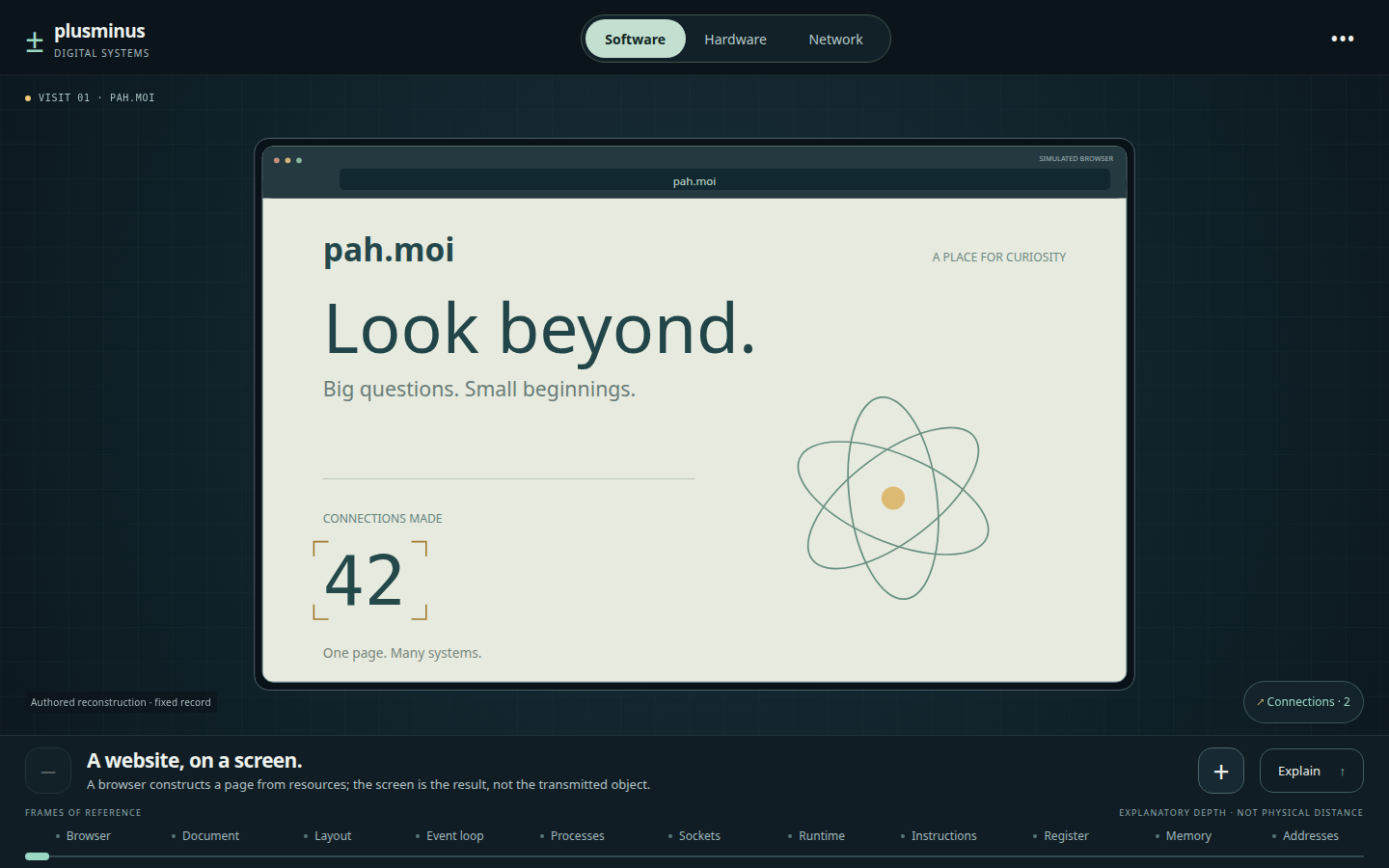
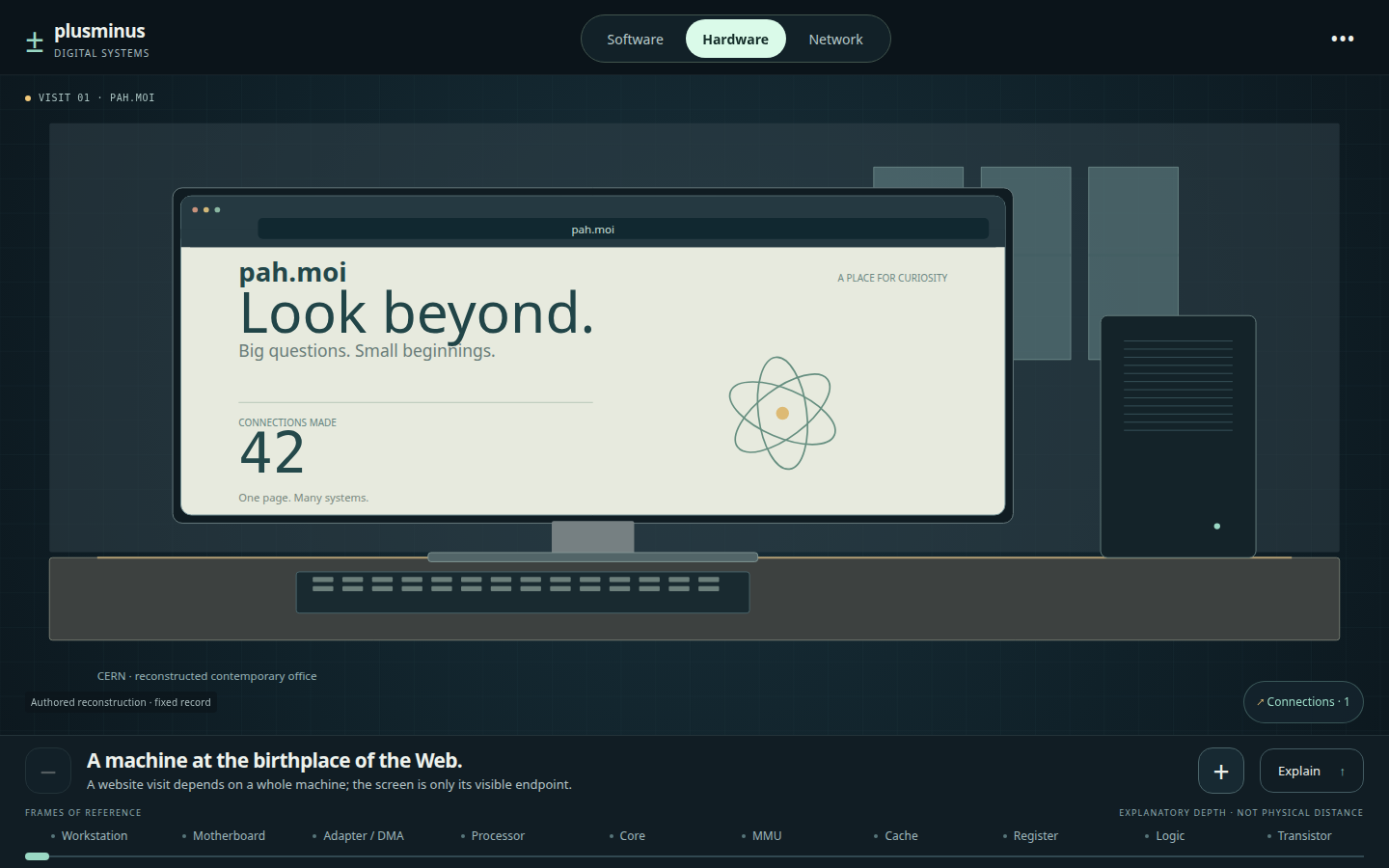
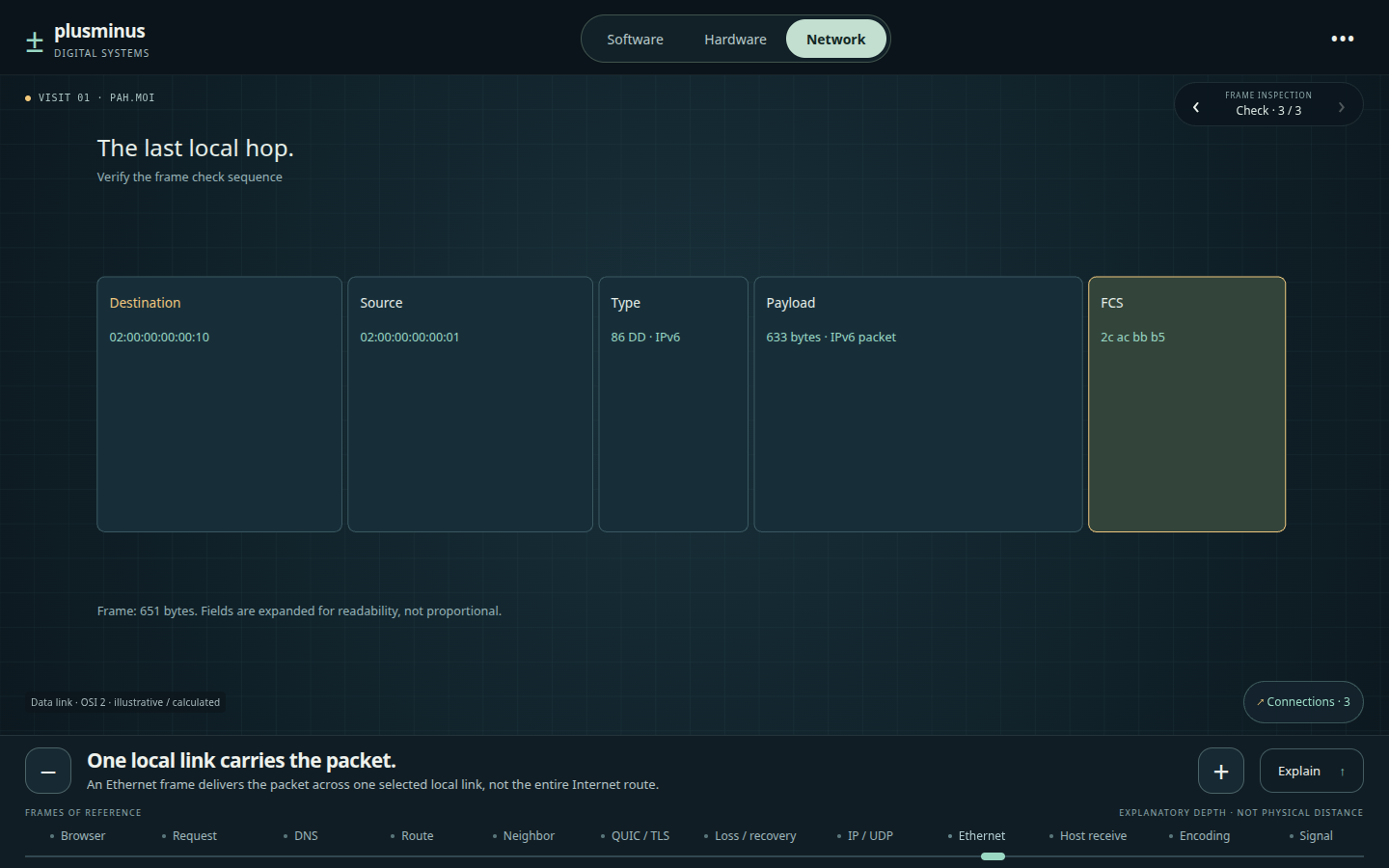
Digital Systems begins with a simulated visit to pah.moi on a modern workstation. Connected Software, Hardware, and Network paths investigate browser rendering, instructions, registers, memory, packets, and physical signalling. Selected calculations and shared records connect the diagrams to the same underlying examples.
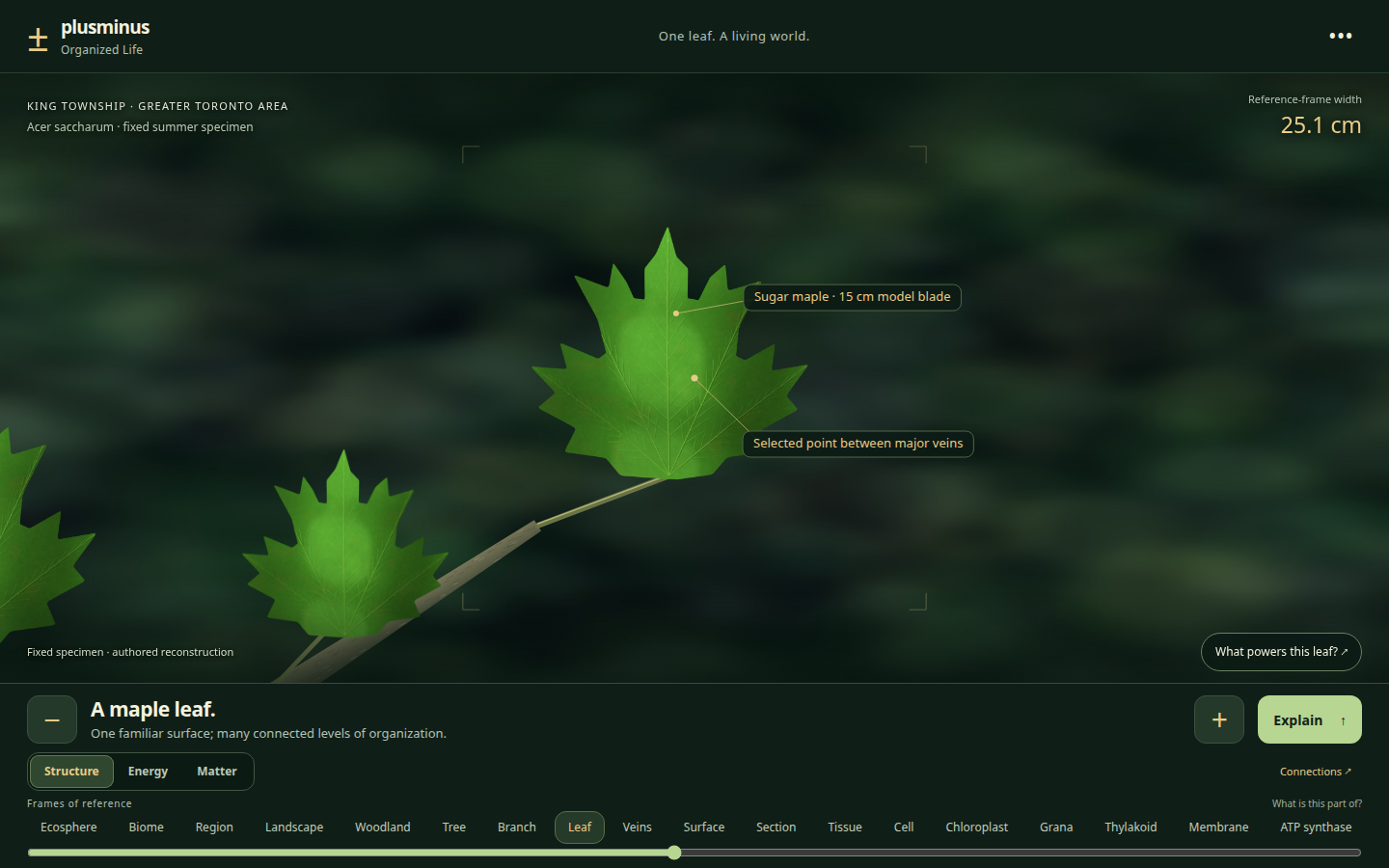
Organized Life begins with a reconstructed sugar maple leaf in the Greater Toronto Area. The Structure journey connects molecular chemistry, cells, the leaf, woodland, biome, and ecosphere. Energy and Matter investigations explore sunlight, ATP, carbon fixation, and the exchanges that sustain the leaf.
The common idea is not simply to reveal smaller things, but to preserve understanding as the frame of reference changes. Physical distance, explanatory depth, and process state remain distinct. Sources, assumptions, and representation labels distinguish observational material from reconstructions, calculated examples, and speculation. plusminus is an exploration of connected ideas, without claiming to simulate every detail of nature or a working computer.
Screenshots